FDI enterprises engaging in retail business in Vietnam are subject to strict regulatory control over business conditions, scope of operations, and licensing mechanisms under specialized laws. Correctly determining the retail business model, foreign-invested capital structure, and applicable licenses is decisive for the legality of the entire business operation.
FDI enterprises engaging in retail business in Vietnam are governed by a specialized legal framework on investment and commerce. Retail activities of FDI enterprises not only depend on registered business lines but are also subject to market access restrictions. The implementation of retail business must comply with WTO commitments and Vietnamese laws.
Pursuant to Clause 7 Article 3 of Decree No. 09/2018/ND-CP, retail activity is understood as the sale of goods to individuals, households or other organizations for consumption purposes. For an FDI enterprise to conduct retail activities in Vietnam, it must simultaneously satisfy both investment conditions and commercial conditions. Accordingly, the prerequisite condition is to obtain the necessary licenses, namely a Business License, or both a Business License and a Retail Outlet Establishment License. Incorrect determination of the scope of retail activities leading to failure to obtain the proper license may result in license revocation or termination of business operations.
Read more: Foreign Investment Legal Advisory in Vietnam
FDI enterprises conduct retail business through two main commercial models in the Vietnamese market: retail distribution via online space through e-commerce platforms, and establishment of physical retail outlets.
Retail via e-commerce includes the establishment of sales websites, applications providing e-commerce services such as TikTok, Facebook,… or selling through e-commerce marketplaces such as Shopee, Lazada, Tiki,… The transaction process under this model takes place entirely in a digital environment. Consumers access product information, conclude commercial contracts and make online payments. Goods are then dispatched from warehouses and delivered directly to buyers through logistics networks. The operation of online platforms enables economic organizations to digitalize the entire process of goods sales and supply chain management.
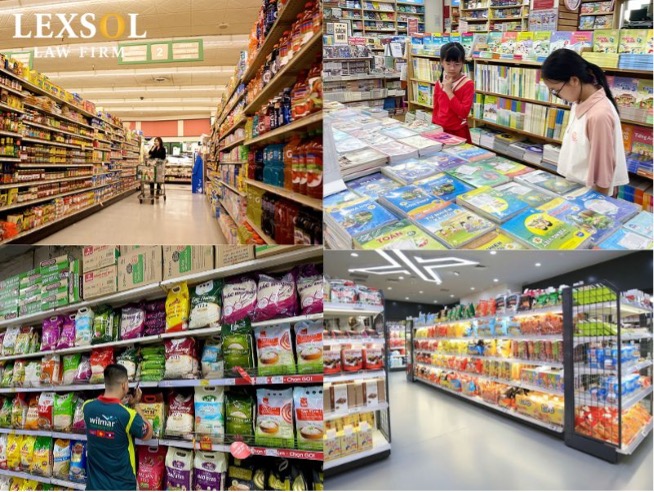
The model of establishing physical retail outlets requires an FDI enterprise to set up a location for conducting retail activities. This location may be structured as convenience stores, supermarkets, shopping centers or other independent retail formats. Retail activities under this model take place through direct physical interaction between sellers and buyers. Customers are entitled to inspect and experience goods before completing transactions and making payments at the counter. This model creates a physical touchpoint, supporting enterprises in building brand recognition in the market.
FDI enterprises engaging in retail business in Vietnam must simultaneously satisfy licensing requirements and business conditions as prescribed by law. Two main groups of licenses governing retail activities include the Business License and the Retail Outlet Establishment License.
Pursuant to Article 5 of Decree No. 09/2018/ND-CP, firstly, the Business License is a prerequisite condition for an FDI enterprise when exercising retail distribution rights. This license allows the enterprise to conduct the purchase and sale of goods and directly related activities. The application dossier includes a business plan, explanation of conditions and financial capacity.
Next, the Retail Outlet Establishment License applies to each specific retail location. Each store, supermarket or sales point must be licensed separately. This creates a control mechanism over the number and location of retail outlets of FDI enterprises.
Example application:
3.1.1. Only retailing goods through online channels (website, e-commerce marketplace), without a physical store: Business License.
3.1.2. Retailing goods via online channels and simultaneously opening physical retail stores: Business License and Retail Outlet Establishment License.
3.1.3. Opening a showroom for product display, without on-site sales, with sales conducted via online channels: Business License.
3.1.4. Opening a showroom combined with on-site sales and maintaining online sales channels: Business License and Retail Outlet Establishment License.
Accurate determination of the licensing structure helps enterprises optimize operational processes and ensure legal compliance, avoiding legal risks in the future.
Conditions for granting a Business License are stipulated in Article 9 of Decree No. 09/2018/ND-CP. An FDI enterprise must satisfy criteria on compliance with international treaties, financial plan and absence of overdue tax debts. In addition, the goods traded must not fall under prohibited or restricted categories.
3.2.1. Firstly, business activities must be consistent with Vietnam’s market access commitments under WTO and relevant international treaties. For goods not yet committed or subject to restrictions, the licensing authority will consider granting approval based on additional assessment of market impact such as the competitiveness of domestic enterprises, job creation capacity,… and specialized legal regulations.
3.2.2. Secondly, the enterprise must demonstrate financial capacity to implement feasible business activities. The explanatory dossier must clearly present investment scale, capital sources, distribution model, target customers and development plan for retail activities. The licensing authority evaluates feasibility based on the consistency between business objectives and the actual financial resources of the enterprise.
3.2.3. Thirdly, the enterprise must not fall under cases of serious violations of tax, customs or commercial laws during its operation in Vietnam, if it has been established in Vietnam for 01 year or more.
In addition to the above three conditions, the goods traded must not be on the list of prohibited or suspended goods and must comply with sector-specific conditions (if any). In practice, the explanation of licensing conditions plays a decisive role, especially in cases where consultation with the Ministry of Industry and Trade is required.
Notes for the following goods:
a. For lubricants: Consideration for granting import rights and wholesale distribution rights to FDI enterprises engaged in manufacturing in Vietnam or permitted to distribute in Vietnam.
b. For rice; sugar; recorded items; books, newspapers and magazines: Consideration for granting retail distribution rights to FDI enterprises that already have retail outlets in the form of supermarkets, mini-supermarkets or convenience stores for retail at such outlets.
Conditions for granting a Retail Outlet Establishment License are stipulated in Article 22 of Decree No. 09/2018/ND-CP and apply to each specific retail location. Unlike the Business License, this license focuses on controlling planning, market density and economic impact of each retail outlet. Licensing is conducted on a per-location basis and does not apply to the entire system.
Regarding general conditions, the enterprise must have a location for establishing a retail outlet in line with local commercial development planning. This location must meet requirements on land use purpose, area scale and must not fall within restricted business zones. At the same time, the enterprise must have a financial plan for establishing the retail outlet and must not have overdue tax debts, if it has been established in Vietnam for 01 year or more.
In cases where the Economic Needs Test (ENT) is required to control the expansion of retail systems of FDI enterprises, the licensing authority will additionally assess the following factors:
3.3.1. Size of the geographic market area affected when the retail outlet operates;
3.3.2. Number of existing retail outlets in the geographic market area;
3.3.3. Impact of the retail outlet on market stability and business activities of retail outlets and traditional markets in the geographic market area;
3.3.4. Impact of the retail outlet on traffic density, environmental sanitation, fire prevention and firefighting in the geographic market area;
3.3.5. Contribution of the retail outlet to socio-economic development of the geographic market area, such as job creation, contribution to the State budget,...
Conversely, in certain cases, enterprises are exempt from ENT, including retail outlets with an area of less than 500m², located in shopping centers or not classified as supermarkets or shopping malls. ENT exemption significantly shortens licensing time and reduces the level of appraisal.
 4. Licensing Timeline
State authorities stipulate specific timelines for appraisal of the two types of licensing dossiers. The processing time depends on the type of license. Understanding this timeline helps FDI enterprises proactively plan retail operations, control the schedule for establishing retail outlets and minimize operational disruptions.
For the Business License, pursuant to Article 13 of Decree No. 09/2018/ND-CP, the licensing time in cases where the dossier is valid and no consultation with the Ministry of Industry and Trade is required is approximately 10–13 working days. Where consultation is required, the total licensing time is approximately 16–21 working days.
For the Retail Outlet Establishment License, administrative procedures are divided into two cases under Articles 28 and 29 of Decree No. 09/2018/ND-CP. In cases not subject to ENT, the total licensing time is approximately 20–23 working days. In cases subject to ENT, the total licensing time is approximately 58–61 working days.
FDI enterprises need to develop a transparent legal strategy and thoroughly review potential legal risks before market entry. Assessment of business conditions ensures that dossier appraisal proceeds on schedule.
5.1. Prioritize selecting locations within shopping centers or projects approved under detailed commercial planning to reduce licensing risks.
5.2. Fully and accurately review registered business lines related to planned retail activities.
5.3. Compare WTO commitments and Vietnamese laws to determine the permissible scope of retail business.
5.4. Clearly distinguish between wholesale and retail activities to determine licensing obligations.
5.5. Develop a phased roadmap for expanding retail outlets, avoiding simultaneous submission of multiple licensing dossiers.
5.6. Assess in advance the possibility of applying ENT for the second retail outlet onwards.
5.7. Standardize licensing dossiers, including financial plans, business plans and explanatory contents.
5.8. Establish mechanisms for monitoring and controlling post-licensing compliance for each retail outlet.
5.9. Conduct legal assessment before changing location, scale or retail business model.
The legal framework governing retail business for FDI enterprises in Vietnam imposes strict market access conditions. Proper compliance with procedures for obtaining a Business License and a Retail Outlet Establishment License ensures project implementation timelines for foreign-invested capital. For further inquiries, please contact Lexsol for prompt legal advisory support.


Lexsol is a team of young, dynamic lawyers with over 10 years of experience in advising and resolving legal matters for both domestic and international businesses.


 152-154 Vo Van Kiet Street, Ben Thanh Ward, Ho Chi Minh City, Vietnam
Điền thông tin, chúng tôi sẽ liên hệ tư vấn chi tiết cho bạn trong vòng 24h.


